

Banarasi Saree Guide 101: History, Types, and Design
If you have ever attended a North Indian wedding, you have likely witnessed the distinct, regal shimmer of a Banarasi saree. It is not just a piece of clothing; it is a heavy, lustrous, six-yard canvas of history that has survived centuries of changing fashion trends.
Owning a Banarasi is often considered a rite of passage for Indian women. Yet, for a first-time buyer, the world of Banarasi textiles can be overwhelming. Terms like Katan, Tanchoi, and Jangla are thrown around by shopkeepers, often leaving customers confused about what they are actually paying for.
This guide strips away the jargon to give you a clear, honest look at the heritage, craftsmanship, and varieties of the Banarasi saree. whether you are a bride-to-be or a connoisseur looking to expand your collection.
The Royal Legacy: History of Banarasi Sarees
The story of the Banarasi saree is inextricably linked to the city of Varanasi (formerly Banaras), one of the oldest living cities in the world. While silk weaving in this region finds mention in ancient Buddhist and Hindu scriptures, the Banarasi saree as we know it today is a product of cultural assimilation.
The real transformation happened during the Mughal era. When Persian artisans migrated to India, they brought with them the art of intricate floral motifs (bootis), stylised leaves, and geometric patterns. These Persian aesthetics blended with the indigenous Hindu symbolism of temples and nature. The result was a unique design language—silks adorned with real gold and silver threads (Zari) that became the attire of queens and nobility.
Today, wearing a Banarasi is essentially wearing a piece of that shared history. It is one of the few textiles that has retained its original techniques despite the influx of power looms.
The Making: From Loom to Luxury
What justifies the high price tag of a genuine handloom Banarasi? The answer lies in the time and human labor involved.
A single saree can take anywhere from 15 days to six months to complete, depending on the complexity of the design. The process begins with the preparation of the silk yarn, which is dyed and wound onto spools.
The weaving typically takes place on a pit loom. The master weaver uses a Jacquard mechanism—a series of punch cards that dictate the design. This is the "brain" of the loom. As the weaver throws the shuttle back and forth, the Jacquard system lifts specific threads to create the pattern.
If you look closely at a handwoven saree, you will see minor irregularities. These are not defects; they are the signature of the weaver—a human fingerprint in a world of mass-produced uniformity.
Types of Banarasi Sarees
When you walk into a store, the salesperson will likely categorize sarees in two ways: by the fabric used or by the design technique employed. Understanding this distinction is the key to making a smart purchase.
Categorized by Fabric
The base material determines the drape, weight, and occasion suitability of the saree.
1. Katan (Pure Silk) This is what most people picture when they think of a "wedding Banarasi." Katan is a plain-woven fabric created by twisting pure silk threads together. It is extremely durable and has a distinct, lustrous sheen.
- Best for: Brides and close family members. It holds its shape well and looks regal in photos.
2. Banarasi Georgette (Khaddi) A lighter, more fluid alternative. Georgette is made from highly twisted yarns, giving it a crinkly texture and a bouncy drape. These sarees often feature modern border designs and are significantly easier to carry than heavy Katan silks.
- Best for: Cocktail parties, summer weddings, or for women who find heavy silks cumbersome.
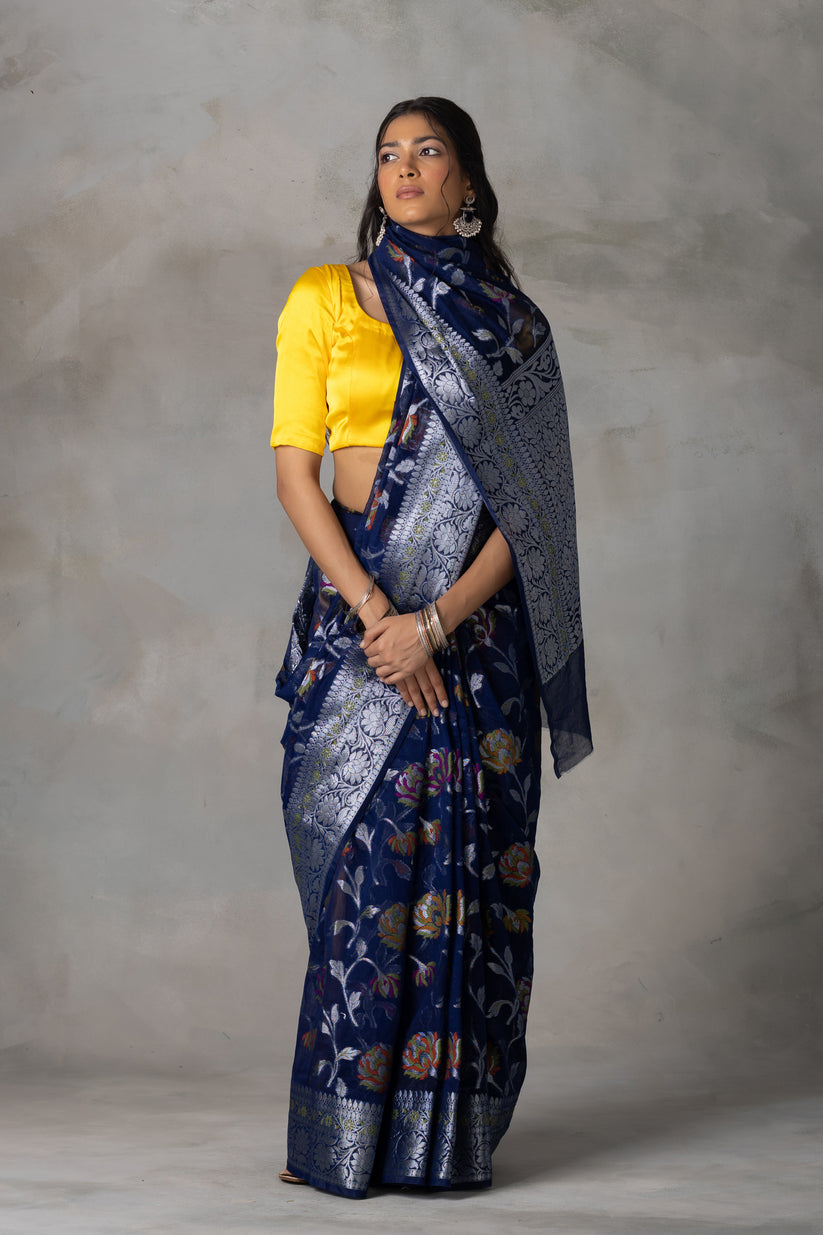
3. Organza (Kora Silk) Organza is characterized by its sheer, crisp texture. It does not cling to the body; instead, it creates a voluminous, structured silhouette. The contrast of the transparent fabric with heavy Zari work is visually stunning.
- Best for: Day events and those who love a structured, voluminous look.
4. Shattir This is a fabric innovation used to create lighter, more affordable designs. Shattir is the sole reason Banarasi sarees are now accessible for casual wear, not just grand weddings.
- Best for: Daily wear or smaller festive occasions.

Categorized by Design
Once you have chosen the fabric, you look at the weaving technique. This defines the visual texture of the saree.
1. Jangla The word comes from Jungle. These sarees are covered in heavy, intricate vegetation motifs—creepers, flowers, and leaves that span the entire body of the saree. It is one of the oldest and most expensive design types due to the density of the Zari.
2. Tanchoi If you dislike the feeling of loose threads on the back of a saree, Tanchoi is for you. This technique uses a satin weave with multiple colors of silk weft, creating a smooth, kaleidoscopic finish on both sides. It rarely uses Zari, focusing instead on silk-on-silk patterns.
3. Vaskat Often referred to technically as a simplified Jamdani, the Vaskat technique allows the silk to be semi-transparent, with the Zari motifs appearing to float on the surface.
4. Butidar The hallmark of a classic Banarasi. The entire saree is dotted with small, repetitive motifs called butis (or bootis). A popular variation is the Ganga-Jamuna style, where gold and silver threads are used together to create a two-toned metallic effect.
5. Cutwork This is the "economical" version of the Jamdani. Threads are floated across the back of the fabric and then manually cut away after weaving. While beautiful, these sarees require care as the cut threads can catch on jewelry.
Real vs. Fake: How to Identify an Authentic Banarasi Saree
The market is flooded with power-loom imitations that look 90% identical to the real thing but cost a fraction of the price. If you are paying for handloom, ensure you are getting it.
1. The Reverse Side Check Turn the saree over. A handwoven Banarasi will often have floats (loose threads) between the motifs. If the back looks perfectly smooth or has a mesh-like net glued to it to hide the threads, it is likely a machine-made product or a polyester blend. Note: Tanchoi sarees are an exception to this rule as they are naturally smooth on the reverse.
2. The Pin Test Pick a discrete part of the saree (like the hem) and gently prick it with a sharp pin. If the threads separate easily and move back when rubbed, it is likely pure silk. If the puncture leaves a permanent hole, the fabric is synthetic.
3. The Zari Test Real Zari is made of silver thread coated in gold. If you scratch a fake Zari thread, it will reveal a white or red nylon core. Authentic, vintage Zari will reveal a reddish or silver core, though mostly today "tested Zari" is used, which mimics the look without the precious metal cost.
4. Silk Mark Certification Always ask for the Silk Mark tag. This is a government-backed certification that guarantees the purity of the silk base.
Styling Your Banarasi: Traditional to Trendy
The versatility of a Banarasi saree lies in how you style it.
- The Traditional Route: For a wedding, pair a red or hot pink Katan saree with a heavy embroidery blouse. Stick to traditional gold temple jewelry or Kundan sets. A neat bun with jasmine flowers completes this timeless look.
- The Modern Twist: To wear a Banarasi to a friend’s reception without looking like the bride, opt for a Georgette or Organza variant in pastel shades like mint green, powder blue, or peach. Ditch the heavy gold jewelry for statement polki studs or a choker. You can even pair the saree with a corset top or a shirt-style blouse for an edgy, editorial vibe.
Care & Maintenance
A Banarasi saree is an investment that should last for generations, but silk is a protein fiber and degrades if mistreated.
- Storage: Never hang a heavy silk saree on a metal hanger for long periods; the weight will distort the weave, and the metal may stain the silk. Wrap the saree in a pure muslin cloth or a cotton saree bag. This allows the fabric to breathe while protecting it from moisture.
- Folding: The Zari can break if the saree is kept folded in the same position for years. Take your sarees out every 4–6 months, air them in the shade (never direct sunlight), and refold them along different lines.
- Washing: Dry clean only. Do not attempt to wash a heavy Zari saree at home. Water can leave permanent spots on silk and tarnish the Zari.
- Ironing: Always iron on a low heat setting, preferably with a layer of cotton cloth between the iron and the saree. Never spray water directly on the fabric while ironing.
Conclusion
The Banarasi saree is more than just a garment; it is a narrative of Indian craftsmanship. Whether you choose the structural elegance of Organza or the fluid grace of Georgette, you are buying a piece of art that supports a weaver's livelihood and keeps a centuries-old tradition alive.
When you drape a Banarasi, you carry a legacy. Choose wisely, care for it deeply, and it will remain a treasured heirloom for decades to come.
Frequently Asked Questions (FAQ)
1. Which Banarasi saree is best for weddings?
For a bride, a Katan Silk Banarasi is the gold standard. Its dense weave and sturdy structure handle heavy Zari embroidery beautifully, ensuring the saree stays crisp and photogenic throughout the ceremony. For wedding guests, a Banarasi Georgette or a lighter Soft Silk is more comfortable for long hours of wear.
2. How to identify pure Banarasi silk saree from a synthetic one?
The most reliable method is the Burn Test. Take a few loose threads from the saree (usually from the fringe/tassels). When burnt, pure silk smells like burnt hair and leaves a crushable, black powdery ash. Synthetic fibers will smell like burning plastic and form a hard, melted bead.
3. What is the difference between Katan and Georgette Banarasi?
The difference lies in the yarn twist and weave. Katan is made from untwisted or low-twist silk threads in a plain weave, resulting in a smooth, stiff, and shiny fabric. Georgette uses highly twisted yarns, creating a crinkly, matte texture that is flowy and drapes closer to the body.
4. Why are Banarasi sarees so expensive?
The cost reflects the labor and materials. A handloom saree requires weeks or months of manual labor by skilled artisans. Additionally, the cost of pure mulberry silk and authentic Zari (often containing silver or gold traces) significantly drives up the price compared to power-loom polyester alternatives.
5. Can I iron my Banarasi saree at home?
Yes, but with extreme caution. Always use a low heat or "Silk" setting. It is best to place a thin white cotton cloth over the saree to prevent the direct heat from damaging the silk or turning the Zari black. Steam ironing is generally safer than dry ironing for delicate weaves.
6. How should I store my Banarasi saree to prevent damage?
Avoid plastic covers, as they can trap moisture and cause the Zari to oxidize (turn black). Store your sarees in white muslin cloth or cotton bags. Keep them in a cool, dry place and refold them every few months to prevent permanent creasing or tearing at the fold lines.